The "27 Club": The Story Behind Rock’s Most Tragic Myth
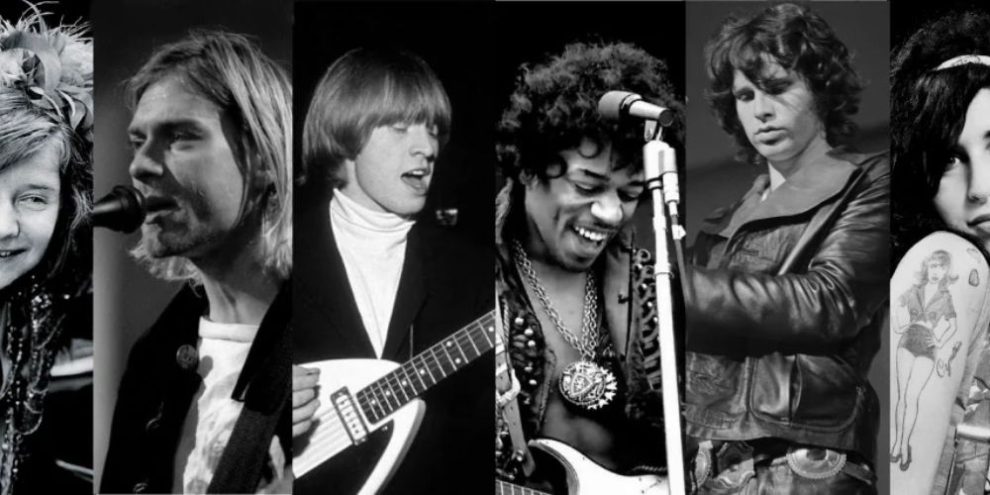
Between 1969 and 1971, four of the most gifted musicians in rock died at the same age. Brian Jones of the Rolling Stones was 27. Jimi Hendrix was 27. Janis Joplin was 27. Jim Morrison of The Doors was 27.
Over the years, others were added to the list: Kurt Cobain in 1994, Amy Winehouse in 2011. The coincidence became a legend with a name: the "27 Club".
It’s a haunting idea, but it’s also easy to let it overshadow the people. These were artists who changed music, and most of them were just getting started. This story is about the myth, but mostly it’s about the music they left behind.
Snag Our Newsletter
What Is the "27 Club"?
The "27 Club" is an informal list of mostly popular musicians who died at age 27. It isn’t an actual club, of course, and there’s no official membership. It’s a piece of pop culture lore that grew out of a cluster of deaths and a lot of storytelling.
The idea took shape after the deaths of Jones, Hendrix, Joplin and Morrison between 1969 and 1971, which fans noticed at the time. But the phrase itself became widely known after Kurt Cobain died in April 1994. His mother reportedly told a local newspaper that he had “joined that stupid club,” and what she meant by it is still debated. When Amy Winehouse died at 27 in 2011, the idea returned with new force.
Many of these stories involve addiction and mental health struggles. That’s part of why it’s worth telling them with care.
The Cluster That Started It All
In a little over two years, rock lost four of its most important voices.
- July 3, 1969: Brian Jones, founder of the Rolling Stones
- September 18, 1970: Jimi Hendrix
- October 4, 1970: Janis Joplin, just 16 days after Hendrix
- July 3, 1971: Jim Morrison, two years to the day after Jones
Just before Hendrix and Joplin, on September 3, 1970, Alan “Blind Owl” Wilson of Canned Heat died at 27 as well. In the space of about a month, three gifted musicians were gone.
The Big Six: Their Music and Legacy
Brian Jones (1942 to 1969)
Who he was: The founder of the Rolling Stones, and the band’s early driving force. Jones was a gifted multi-instrumentalist who brought colours to the Stones’ sound that other rock bands didn’t have.
His music: Jones played slide guitar, harmonica, and unusual instruments like the sitar on “Paint It Black,” the marimba on “Under My Thumb” and the dulcimer on “Lady Jane.” Those textures helped turn the Stones from a blues band into something more adventurous.
His end: By 1969, Jones had grown estranged from the band, and he left in June. He died less than a month later at his home in Sussex, England.
Legacy: Many fans still point to his work as a reminder of how much the Stones’ early sound owes to him. The Rolling Stones were inducted into the Rock and Roll Hall of Fame in 1989.
Listen to: “Paint It Black,” “Under My Thumb”
Jimi Hendrix (1942 to 1970)
Who he was: Widely regarded as one of the greatest electric guitarists of all time. Hendrix reshaped what the instrument could do.
His music: In 1967, the Jimi Hendrix Experience released the debut album Are You Experienced, featuring “Purple Haze,” “Hey Joe” and “The Wind Cries Mary,” and the London scene had to adapt to his style. His blend of blues, rock, psychedelia and feedback pushed the guitar into new territory. His performance of “The Star-Spangled Banner” at Woodstock in 1969 became one of the defining moments of the era.
His end: Hendrix died in London on September 18, 1970, while still working on new music.
Legacy: The Experience was inducted into the Rock and Roll Hall of Fame in 1992, and his influence runs through nearly every generation of rock guitarists since. It’s impossible to know what he’d have done next.
Listen to: “Purple Haze,” “Little Wing,” “Voodoo Child (Slight Return)”
RELATED: Discover more about Jimi Hendrix’s life and legacy ...
Janis Joplin (1943 to 1970)
Who she was: A Texas-born singer who broke through with Big Brother and the Holding Company and became one of rock’s most powerful voices.
Her music: Joplin could rip through a blues number with raw emotion that few singers have matched. “Piece of My Heart” became her signature, and “Ball and Chain” showed what she could do live.
Her end: Joplin died on October 4, 1970, while recording her second solo album.
Legacy: That album, Pearl, came out posthumously in January 1971 and topped the Billboard 200 for nine weeks. Its single “Me and Bobby McGee,” a Kris Kristofferson song she made her own, became her first number one. She was inducted into the Rock and Roll Hall of Fame in 1995, and she remains an enormous influence on women in rock.
Listen to: “Piece of My Heart,” “Me and Bobby McGee,” “Mercedes Benz”
Jim Morrison (1943 to 1971)
Who he was: The lead singer and lyricist of The Doors, a poetic, brooding frontman whose baritone defined the band.
His music: The Doors combined blues, rock and psychedelia with Ray Manzarek’s organ at the centre. “Light My Fire” went to number one in 1967, and the band built a catalogue that includes “Break On Through,” “Riders on the Storm” and “L.A. Woman.”
His end: Morrison died in Paris on July 3, 1971, just months after L.A. Woman came out.
Legacy: The Doors were inducted into the Rock and Roll Hall of Fame in 1993. His grave at Père Lachaise cemetery in Paris is still one of the city’s most visited.
Listen to: “Light My Fire,” “Riders on the Storm,” “L.A. Woman”
Kurt Cobain (1967 to 1994)
Who he was: The singer, guitarist and principal songwriter of Nirvana, and the reluctant voice of a generation.
His music: Nirvana’s 1991 album Nevermind brought grunge to the mainstream, led by “Smells Like Teen Spirit.” The band’s music was melodic and raw at the same time, and Cobain’s lyrics were honest, dark and often funny. In Utero (1993) was a rawer follow-up, and MTV Unplugged in New York showed a quieter, more vulnerable side.
His end: Cobain struggled with addiction, health problems and depression, and he died by suicide in April 1994.
Legacy: MTV Unplugged in New York was released later that year. Nirvana was inducted into the Rock and Roll Hall of Fame in 2014, in the first year they were eligible. His influence on alternative rock is enormous, and his death has remained a reminder of how serious the pressures of fame and mental health can be.
Listen to: “Smells Like Teen Spirit,” “Come as You Are,” “About a Girl” (Unplugged)
Amy Winehouse (1983 to 2011)
Who she was: A London singer-songwriter whose voice and style drew on jazz, soul and 1960s girl groups.
Her music: Her second album, Back to Black (2006), spawned “Rehab,” “You Know I’m No Good” and the title track. At the 2008 Grammys, she won five awards, including Record of the Year and Song of the Year for “Rehab,” plus Best New Artist.
Her end: Winehouse died in July 2011 after a long struggle with addiction.
Legacy: Back to Black has sold more than 20 million copies worldwide and helped open the door for a generation of soul-influenced pop singers.
Listen to: “Back to Black,” “Rehab,” “Love Is a Losing Game”
Others Remembered
The "27 Club" list is longer than most people realize. Here are some of the other musicians often included, and the music they left behind.
- Robert Johnson (1911 to 1938): The Mississippi blues legend whose small catalogue influenced generations. He’s often called the original member of the club, though the idea was applied to him long after his death.
- Alan “Blind Owl” Wilson (1943 to 1970): The singer, harmonica player and songwriter of Canned Heat. He wrote and sang “On the Road Again” and “Going Up the Country,” which became an unofficial theme of Woodstock.
- Ron “Pigpen” McKernan (1945 to 1973): A founding member of the Grateful Dead, whose bluesy vocals, organ and harmonica gave the early band its roots. The Dead were inducted into the Rock and Roll Hall of Fame in 1994.
- Pete Ham (1947 to 1975): The Badfinger singer and songwriter who co-wrote “Without You” and wrote “No Matter What.”
- Dave Alexander (1947 to 1975): The original bassist of The Stooges.
- Chris Bell (1951 to 1978): The Big Star co-founder whose music found a devoted following long after his death.
- Kristen Pfaff (1967 to 1994): The Hole bassist, who died just two months after Cobain.
- Richey Edwards (1967 to 1995): The Manic Street Preachers lyricist and guitarist, who disappeared in February 1995 and was declared presumed dead in 2008.
A Canadian Connection: The 1970 Festival Express
Two members of the "27 Club" shared a stage in Canada in the summer of 1970.
That year, Janis Joplin, the Grateful Dead (with Pigpen on harmonica and vocals), The Band, Buddy Guy and others boarded a chartered train for the “Festival Express” tour. It played Toronto at CNE Stadium on June 27 and 28, Winnipeg on July 1 and Calgary on July 4 and 5. The tour lost money, but the performances and the jam sessions on the train became legendary and were captured in a 2003 documentary, Festival Express.
Joplin died about three months later. Pigpen died three years after that. Recordings from the tour, including her performance of “Ball and Chain” in Calgary, were later released, and they’re a reminder of how alive she sounded on a Canadian summer stage.
Her final band, the Full Tilt Boogie Band, also had a Canadian connection: its members included guitarist John Till and pianist Richard Bell, both from Canada, who played on Pearl.
Is the "27 Club" Real?
Short answer: not statistically.
Researchers have tested the idea. A 2011 study in the British Medical Journal looked at 522 famous musicians and found no spike in deaths at 27. Of those musicians, only three died at 27, and death rates at 25 and 32 were about the same. The authors concluded that the "27 Club" was created by a combination of chance and cherry-picking.
A 2014 analysis by Australian researcher Dianna Kenny found that popular musicians were most likely to die at 56, at a rate of 2.2 per cent, compared with 1.3 per cent at 27.
But the studies also pointed to a harder truth. The BMJ research found that famous musicians in their 20s and 30s faced a risk of death two to three times higher than the general population. Fame, touring, addiction and mental health struggles take a real toll, and that’s true at 27, 31 and 45 alike.
The "27 Club" is a myth. The loss behind it isn’t.
RELATED: More rock and roll legends: fact or fiction? ...
What Matters Most Is the Music
It’s easy to fixate on how these artists died and on the number 27. It’s harder, and more worthwhile, to remember what they made; their art, and their legacies.
Hendrix rewrote the guitar. Joplin sang with a rawness few have equaled. Morrison and The Doors turned rock into poetry. Jones helped shape the Rolling Stones’ sound. Cobain wrote melodies that still define a generation. Winehouse brought soul back to pop.
Every one of them left a catalogue that’s still getting discovered by new listeners today. That’s the part worth celebrating.
If you or someone you know is struggling, help is available. Reach out to a mental health professional, a trusted person or a local crisis line. Visit CAMH Crisis Resources for more.
Snag Our Newsletter
Hit that button like you’re pressing play on your favourite track. get exclusive content, stories, and news.
Related




Upcoming Concerts